

Envision360
Schedule a call
Case Study: Multi-Vendor Order & Fulfillment Portal | Envision360
Case study

Multi-vendor order & fulfillment portal

This client is a mid-sized North American distributor working with independent vendors. Orders were not the problem. The messy part was everything after the order. Status lived in too many places, and the ops team spent a lot of time chasing updates.

Vendors were all different. Some had portals. Some had spreadsheets. Some were email-only. Every new vendor added more moving parts, and the customer experience depended on who replied fastest. They wanted one place where orders, tracking, and vendor accountability are obvious.

Client at a glance

  • Vendors: independent suppliers with mixed systems
  • Pressure point: tracking split across email, spreadsheets, and portals
  • Goal: unified orders, live status, and vendor performance visibility

They were not asking for “more software”. They were asking for fewer surprises. If something is late, the team should see it early, and customers should get a real update with context.

B2B order and fulfillment portal overview

Challenge

The process worked until volume grew. Then small gaps became daily fires. A ship date would change without notice. Tracking would be missing. Ops would find out when a customer called frustrated.

  • Order tracking: no single source of truth
  • Delays: late updates meant reactive communication
  • Reporting: every vendor reported differently
  • Coordination: time spent chasing, not improving
  • Scale: each new vendor increased complexity

They needed a single portal that vendors would actually use, and ops could trust.
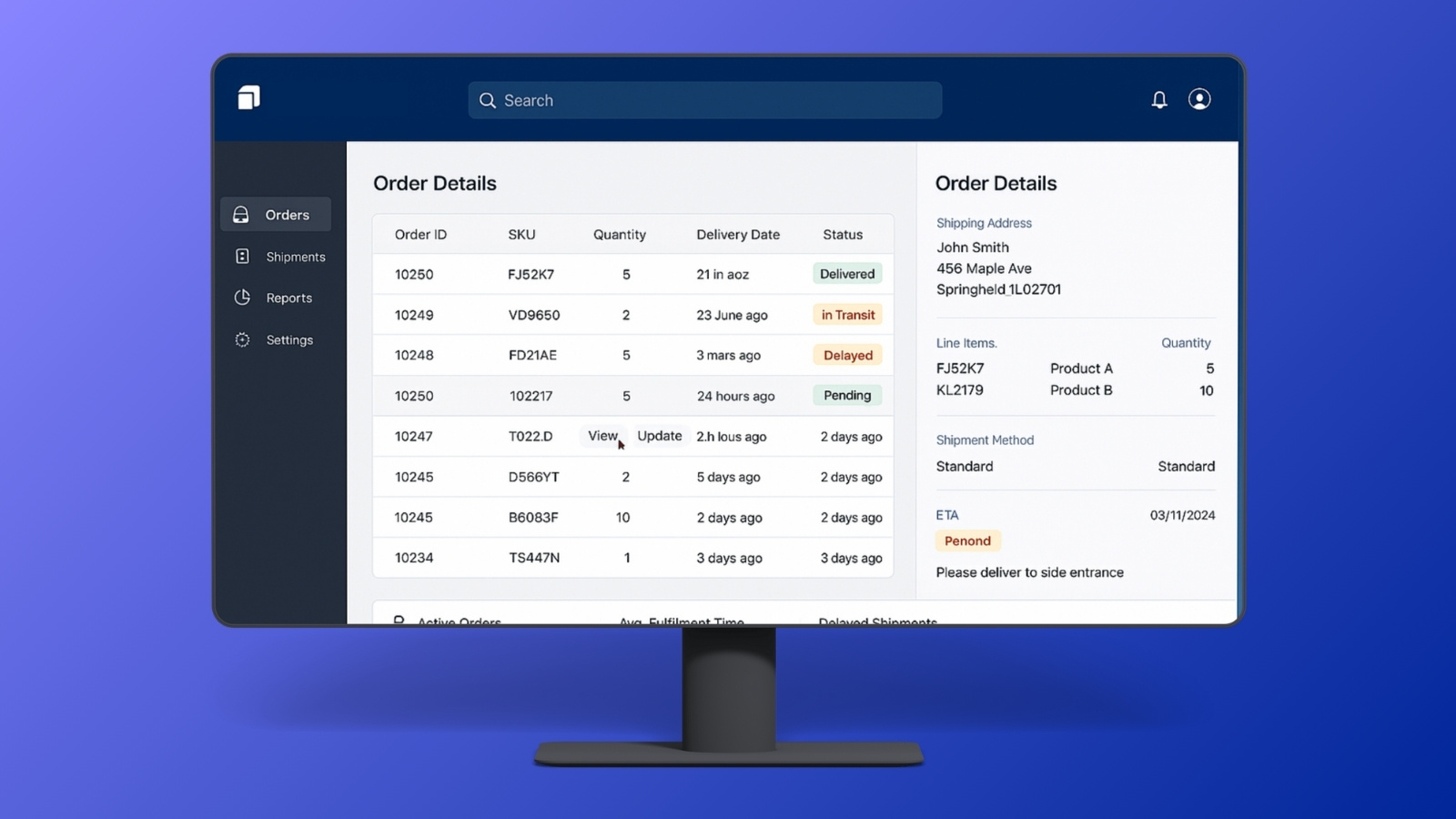
Order status and analytics views
Our solution

One portal. Clear status. Vendor accountability.

We built a multi-vendor portal that keeps orders and updates in one place. Vendors get a clean list of what they own. Ops gets visibility, control, and a full history of changes. The goal was simple. Make the truth obvious without making vendors feel like they are doing extra work.

Unified vendor portal

Every vendor sees assigned orders with the details they need.

  • SKU, quantity, ship-to, priority, instructions
  • Role-based access for vendor users and ops

Live tracking

Status from received to delivered, plus exception flags.

  • Carrier and vendor integrations where available
  • Delay, partial, and exception workflows

Order-based messaging

Short notes tied to the order replace email chaos.

  • Escalations for urgent orders
  • Full timeline of updates and comments

Analytics & reporting

Dashboards that answer basic questions fast.

  • On-time rate, SLA adherence, volume
  • Exports for ops and finance

Scalable onboarding

New vendors can ramp quickly with minimal training.

  • Self-serve users and permissions
  • Guided setup and templates
Technology

Fast, reliable, and secure.

Vendor dashboard

  • Responsive for desktop and tablet
  • Quick status updates
  • Simple upload for tracking docs

Ops console

  • Full visibility across vendors
  • Exception handling workflows
  • Audit trail for changes

Integrations

  • Carrier and vendor connections
  • Webhook style updates where possible
  • Manual fallback when needed

Data & performance

  • Caching for fast dashboards
  • Normalized status model
  • Reporting-ready structure

Security

  • Role-based access
  • TLS in transit
  • Audit logs for changes
Pilot

How it rolled out.

We started with ten vendors on purpose. Different volumes, different habits, different systems. The first win was standardizing statuses so leadership could trust reporting. The second win was making updates fast enough that vendors did not avoid the portal.

  • Pilot with ten vendors across mixed volumes
  • Normalization: shared status map and ID structure
  • Adoption: short training and vendor-friendly flows
  • Coverage: integrations where possible, manual fallback where needed
  • Early weeks reduced follow-ups and improved customer updates
Impact

First 90 days.

  • Fulfillment visibilityfrom 45% to 96%
  • Late shipment ratefrom 28% to 9%
  • Manual follow-upsfrom daily to occasional
  • Onboarding timefrom 3 to 4 weeks to under 1 week
  • Reportingfrom monthly manual to real time
Roadmap

What is next.

Once the base system was trusted, the focus shifted to catching issues earlier. More carrier coverage, stronger vendor scorecards, and proactive alerts for likely delays.

  • More carrier coverage and better tracking depth
  • Predictive alerts for likely delays
  • Vendor scorecards with automated escalation
  • Embedded invoicing and payments

Client: Name Withheld — Multi-vendor distribution network

Schedule a call or contact us to plan your vendor portal rollout.