
The price is hours times the team you need
Every custom software quote is built the same way. Someone estimates the hours of work, decides who has to do that work, and multiplies. If two quotes for the same project are far apart, it is almost always because the two firms are picturing different amounts of work, not because one is cheap.
That is good news. It means you can read a quote, and you can change it.
Scope sets the hours
Features are the largest part of any estimate, and they are not equal. In our own app cost calculator a login with user profiles is planned at about 60 hours. A checkout with a cart is about 100. Offline mode, where the app keeps working without a signal and syncs later, is about 140.
A feature that sounds small in a meeting can be the biggest line on the estimate. Offline mode is the usual example.
Start here:
- Write down what a user must be able to do on day one. Not what would be nice.
- Mark every item that touches payments, health data or another system.
- Ask for the estimate by feature, in hours, so you can see where the time goes.
Integrations add up quietly
Most business software has to talk to something you already run: accounting, a CRM, a booking system, an ERP. We plan about 60 hours for each integration, and more when the other system is old or poorly documented.
Count them before you ask for a quote. Three integrations is roughly a month of one developer's time before a single screen is built.
Compliance is real work
If the software handles health information, card payments or enterprise customer data, the rules are part of the build. In our planning, HIPAA work is about 280 hours, SOC 2 readiness about 280 and PCI about 200. Those hours cover access controls, audit logs, encryption and the documentation an auditor will ask for.
This is the line owners most often leave out of their own budget, and the one that is hardest to add later.
Start here:
- Ask whether the data you plan to store falls under HIPAA, PCI or a customer security review.
- If it does, put it in the first estimate, not a later phase.
Design is a line item
If you arrive with finished designs, the build starts sooner. If you do not, plan for about a month of design on a simple product, two for a mid-sized one and three for a complex one. Skipping design does not remove the work. It moves the decisions into the build, where they cost more to change.
Team size changes the calendar and the monthly bill
A team of four moves at one pace. A team of six or nine finishes sooner and costs more each month. Where the team sits matters as well, since local, nearshore and offshore developers are priced differently.
As a rough guide to timing, a focused first release with the core flows takes 6 to 12 weeks. A product with several features and several connected systems takes 3 to 6 months.
What sits outside the build
Three costs are easy to miss:
- Launch and polish. Keep 10 to 20 percent of the budget for the final stretch. Real users find things testers do not.
- Hosting. Cloud costs for a small first release often land between $150 and $600 a month, and grow with use.
- Support. Monitoring, fixes, security updates and small improvements are an ongoing cost, not a one-time one.
How to get a number you can trust
- Bring a one-page description of who uses the software and the three things they must be able to do.
- Ask for hours by feature, the team behind those hours, and what is assumed.
- Ask what happens when scope changes. A clear change process is worth more than a low first number.
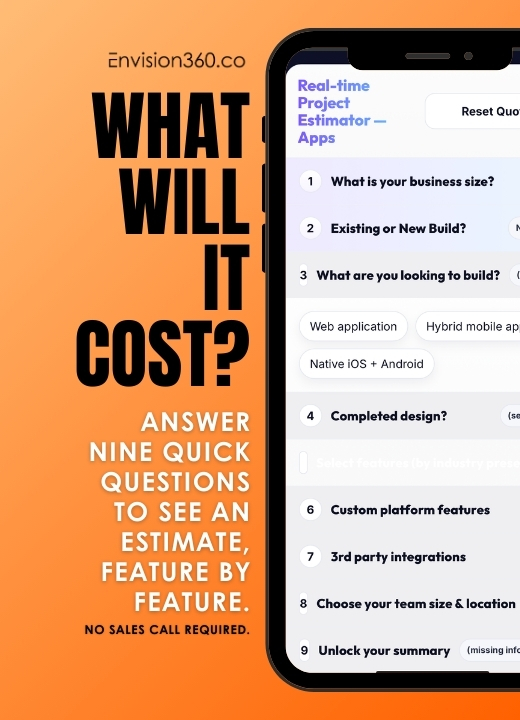
Next step: build your own estimate in the app cost calculator. It shows the hours behind each choice, so you can see what moves the total before you talk to anyone.