
An app budget is five decisions
People ask what an app costs the way they ask what a house costs. The answer depends on what you are building. The useful part is that only a handful of decisions drive the number, and you can see each of them coming.
1. Which platforms you build for
This is the first fork, and it is a big one.
- Web application. Runs in a browser on any device. One codebase, no app store.
- Hybrid mobile app. One codebase that ships to both iPhone and Android, using tools such as React Native or Flutter.
- Native iOS and Android. Two separate apps, each built for its own platform.
Native gives the most control over performance and device features. It also means building much of the product twice. Most business apps do not need it. If your users mainly fill in forms, look things up and get notifications, hybrid is usually enough.
2. Whether design is done
If you arrive with finished, tested designs, the build can start. If not, design comes first: roughly a month for a simple app, two for a mid-sized one, three for a complex one.
Design is where changes are cheap. A clickable prototype lets real users try the flow before anyone builds it, and moving a button in a prototype takes minutes.
3. What the app has to do
Features are counted in hours, and they vary more than people expect. From our planning numbers:
- Login and user profiles: about 60 hours
- Checkout and cart: about 100 hours
- Offline mode: about 140 hours
- A custom feature unique to your business: about 120 hours each
Four or five features in, you can see how a budget forms.
Start here:
- Cut the first version to what a user needs to finish one real task.
- Put everything else on a list for version two.
- Ask which features on your list are the expensive ones. It is often not the ones you expect.
4. What it connects to
An app that stands alone is rare. Most need to read or write to a system you already have: a CRM, an ERP, a scheduling tool, a payment processor. Plan about 60 hours per integration, and more when the other system is old.
Compliance belongs in this conversation too. Health data, card payments and enterprise security reviews each add a defined block of work, and they are far cheaper to include from the start.
5. Who builds it
A small team of four costs less each month and takes longer. A team of six or nine finishes sooner at a higher monthly cost. Location matters as well: local, nearshore and offshore developers are priced differently, and many projects mix them.
There is no best answer here. A fixed launch date pushes you toward a bigger team. A fixed budget pushes you toward a smaller one and a tighter first version.
How long it takes
A focused first release with the core flows usually takes 6 to 12 weeks. A product with several features and several connected systems takes 3 to 6 months. Keep 10 to 20 percent of the budget for launch and polish.
What it costs after launch
The build is not the last bill. Plan for hosting, app store accounts, monitoring, security updates and the improvements users will ask for in the first month. Cloud hosting for a small first release often lands between $150 and $600 a month.
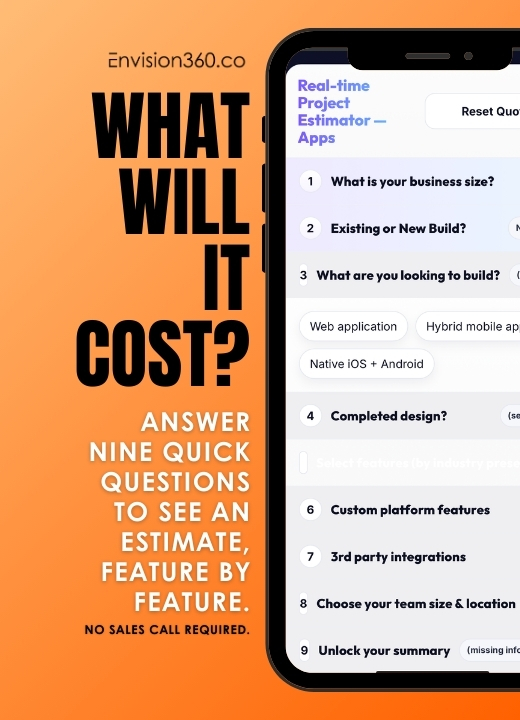
Next step: the app cost calculator walks through these same five decisions and shows the estimate change as you choose. It takes a few minutes and no sales call.